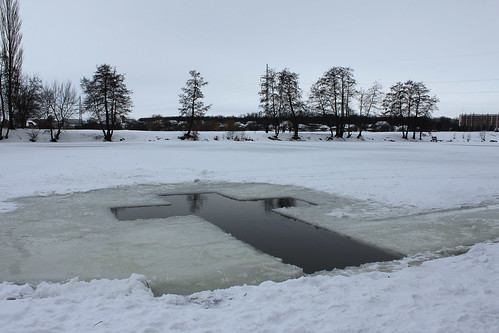
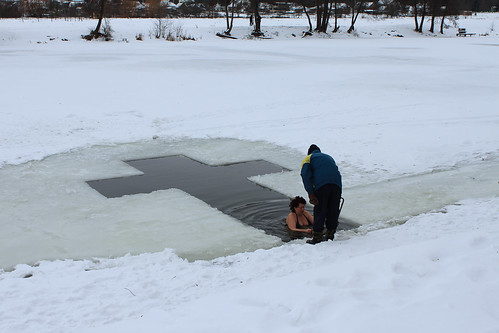
Each year on January 19th they celebrate the Baptism of Jesus and Epiphany by cutting a hole in the ice on the river here in Bila Tserkva. This happens all over Ukraine as people brave the icy waters for a triple dunking. This is an interesting sight in and of itself, but what fascinates me most is the image of the Cross intricately cut into the ice. No matter how many times I see it, I'm always drawn to it and reminded of all that it represents. It is ugly, yet beautiful. It is shameful, yet proud. It is lowly, yet exalted. It is painful, yet comforting. It is weak, yet powerful. It is bondage, yet freedom for those who believe. And if you approach the edge of this particular cross you can see a dim reflection of yourself and the world around you framed in the image of the Cross.
Now we see but a poor reflection as in a mirror; then we shall see face to face. Now I know in part; then I shall know fully, even as I am fully known.- 1 Corinthians 13:12
The first woman of the day to endure a cold dip in the ice with wind chill on the river dropping felt temperature to -21 °C ( -5 °F ).
Some of you might remember a blog I posted almost two years ago about a little boy Joshua met on a playground. The little boy was dirty, his clothes were a mess and the kids were making fun of him. You can read about our first encounter with him by clicking HERE.
Since then we have seen him a few times around the neighborhood and have learned that his name is Kyryl and he is now seven years old. He's a quiet shy boy that Joshua says the other kids aren't very nice to. Joshua has continued to pray for him and an opportunity to show him the love of Christ since that first meeting.
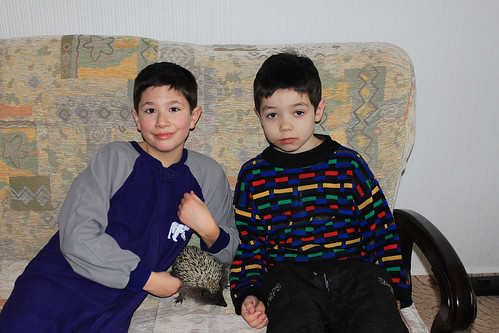
Yesterday, Joshua found Kyryl playing by himself out in the snow and he invited him into our home to play. Kyryl was very excited to see our hedgehog and told us how he likes to find them and play with them. He really liked Taras. Joshua shared some cookies with Kyryl and they played with Legos together until it was time for him to go home.
Joshua decided to give Kyryl most of the Legos he was planning to take back to California with him. I know those were some of Joshua's favorite things, but he never hesitated when he loaded up a plastic bag full of them for Kyryl. We also sent him home with a little Ukrainian story book that explains the life of Jesus and how he died for us. Kyryl was very thankful and polite when he left. It really broke my heart as I helped him get his jacket and boots on to go outside. His clothes were absolutely filthy and his jacket had more holes and patches than I could count. We still don't know much about Kyryl's home life, but we can only imagine. I pray that Jesus will touch his heart and that he will always remember the kind little American boy who keeps a hedgehog as a pet.
This is Kyryl the first time we saw him almost two years ago.
We will be spending Christmas day with our neighbor Olya and her family enjoying a meal that is sure to have way more food than any of us could ever eat. This will be our last Christmas in Ukraine and I wanted to share a little about Ukrainian Christmas with all of our friends and family outside of Ukraine.
"Sviata Vechera - A feast of twelve meatless dishes The rich traditions of Ukraine, dating back through more than a millennium of Christianity to pagan times, have been carried throughout the world to wherever the Ukrainian people have settled. And there is probably no occasion when these ancient customs are held more dear than at Christmas, when families reenact age-old observances that symbolize their deep spirituality, love of family and attachment to the land.
Traditionally Ukrainians have followed the Julian calendar, in which Christmas falls on January 7. These days many Ukrainians in North America join in the holiday festivities surrounding December 25, but continue to place a special religious emphasis on the traditions that mark Ukrainian Christmas, thirteen days later. The days leading up to the celebration are marked by spiritual preparation and fasting. The menu for the "holy supper," or sviata vechera, of Christmas Eve does not contain any meat or dairy products. The meal centres instead around grains, fish, vegetables and fruits; vegetable fats or oils are used instead of butter.
Many of the rites observed during the Ukrainian Christmas Eve meal are very ancient, going back to the pre-Christian era. Early Christians adopted these customs for themselves and invested them with new religious significance. To prepare for the meal, some hay is placed on or under the dining table, representing the manger of the baby Jesus. The table is then laid with the family's finest embroidered tablecloth, or even two tablecloths: one to represent the living members of the family, and one the dead. An extra place is always set for the souls of deceased relatives. Given place of honour in the centre of the table is the Christmas bread or kolach, consisting of three stacked rings. The number represents the Holy Trinity, and the circular shape eternity. A candle is placed in the centre to symbolize Jesus, the light of the world."
"The meal begins once the children of the family sight the first star in the evening sky, recalling the journey of the wise men towards Bethlehem. On farms, the head of the family customarily carries a sheaf of wheat called a didukh into the house, representing the family's ancestors, and places it under the household icons. (Outside, in the barn, animals are traditionally given an extra ration, honouring their role in the first Christmas.) In modern urban celebrations of the Christmas Eve meal, the sheaf may be replaced by a few wheat stalks decorating the table. The meal begins with a prayer and the traditional Christmas greeting "Khrystos rodyvsya!" (Christ is born), to which all respond "Slavite yoho!" (Let us praise him.)
Twelve dishes are served, representing the twelve apostles. Wheat shows its importance once again, for it is the main component of the special first course, called kutia, boiled kernels sweetened with honey and flavoured with poppy seeds or nuts. All members of the family must partake of a little kutia, which symbolizes prosperity for the coming year. An old superstition holds that if some of the wheat sticks to the ceiling when a spoonful of kutia is thrown into the air, the new year will be a prosperous one. These days, your hosts might prefer that this particular tradition be omitted!
Next comes soup: in this case, borshch, the famous beet soup, which for this Christmas Eve meal is made without meat or meat stock. Besides beets, the borshch may contain onions, carrots, cabbage and potatoes.
The central part of the meal is centered around fish and vegetable dishes. Fish is served baked or fried, in aspic, or pickled (perhaps whitefish or herring). An integral part of any Ukrainian meal is pyrohy or varenyky, dough dumplings filled with potato and onion, or perhaps sauerkraut or even fruit. Then there are usually two varieties of holubtsi, cabbage rolls: one stuffed with a savoury rice filling, the other with buckwheat.
There is an assortment of other vegetable side dishes: white beans mashed with onions and garlic; kapusta, or sauerkraut with onions; salads or perhaps marinated beets or mushrooms.
Towards the end of the meal, a compote of dried fruits is brought out. It may include prunes, apricots, apples and figs that have been soaked overnight and cooked with honey.
For dessert, there is an assortment of pampushky, little deep-fried pastries containing various fillings such as poppy seed or dried fruit.
This sacred and festive meal goes on for a long time. For the Ukrainian family it not only brings together decades of memories and reminiscences of beloved family members, but is also a link to centuries of proud tradition. Those gathered around the table are reluctant to get up once the meal has ended and so the family members and guests prolong the celebrations late into the night with the singing of Christmas carols."
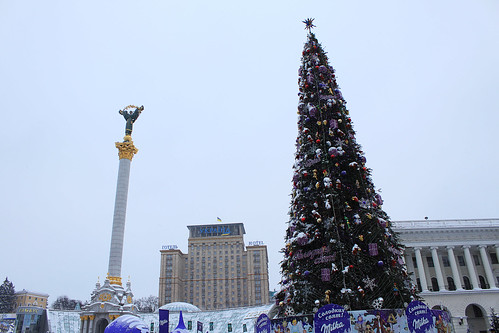
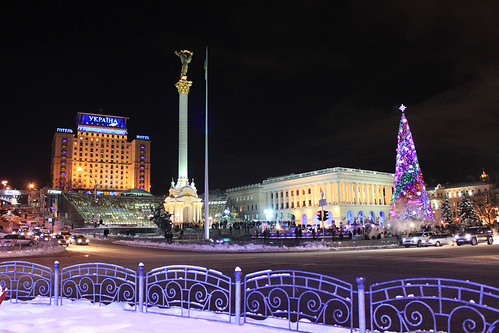
Maidan Nezalezhnosti (Independence Square) in Kyiv
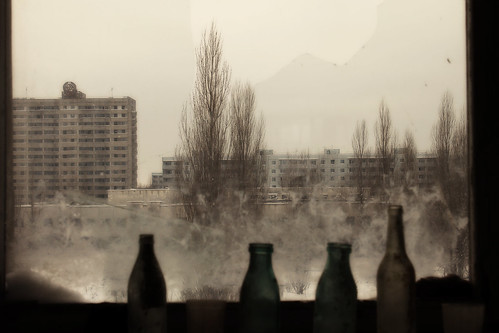
View from one of the rooms in Hotel Polissya in Prypyat
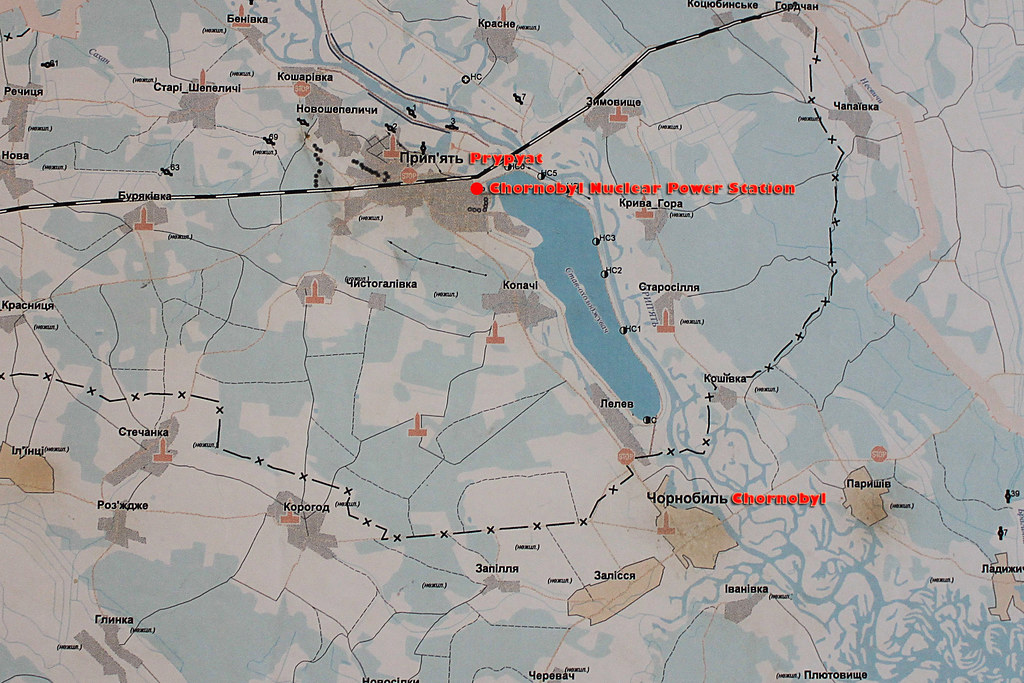
Yesterday I went on a trip to the city of Prypyat and the nearby Chornobyl Nuclear Power Station, formerly known as the V.I. Lenin Nuclear Power Station. Edna arranged it all for my birthday/Christmas present because she knew that I have been fascinated by what happened there ever since working at a nuclear power plant in California when we first got married. It was an amazing opportunity to visit the city that had once been the jewel of the Soviet Union, but had to be completely abandoned with only a two hour notice. (It was replaced by the city of Slavutych, an engineering feat in itself. You can see my post on Slavutych by clicking HERE.)
Over the years the city of Prypyat has been looted and vandalized, but you can still see that it was a beautiful city at one time. Even though it stands in ruins, I can imagine how life there must have been a relative paradise compared with other Soviet cities before the Chornobyl disaster. The true tragedy wasn't the actual accident, but the failure to inform people of the accident and the high levels of radiation they were being exposed to. The 43,000 plus residents of Prypyat weren't told of the danger for almost two days when they were finally evacuated. Had they not been evacuated they would have suffered a lethal dose in four days.
The accident at the Chornobyl Nuclear Power Station and the lack of government intervention to protect the people affected by it is very personal to us. We know so many people who were physically affected by the immediate fallout and children who would later be born with birth defects attributed to the radiological release from the accident. Our neighbor Olya told us how people here in Bila Tserkva, including herself, were outdoors breathing in radioactive particulates because they weren't told about the accident. Even after the accident was made public, people were told that there was no danger to their health. She told us that the doctors suspect that a bone disorder she has is related to her exposure.
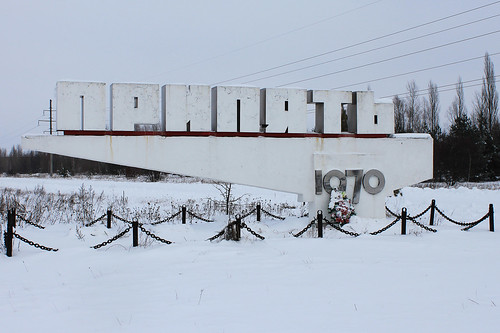
The road into Prypyat with the name of the city and its founding year of 1970
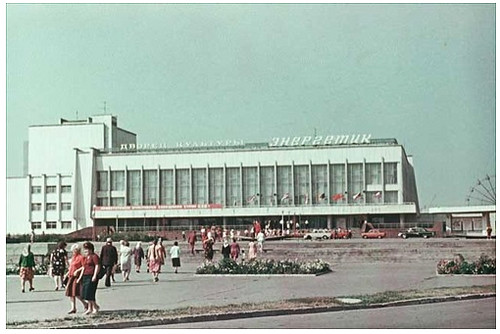
Then: The palace of culture "Energetic", shortly before the April 26th, 1986 accident.
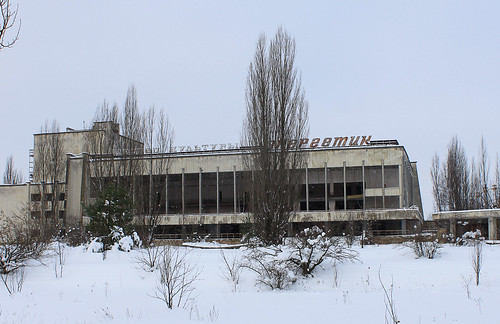
Now: January 4th, 2010, almost 23 years later.
Not to be confused with the Chornobyl Nuclear Power Station, the town of Chornobyl is 18 kilometers south of where the accident occurred. It had a population of 14,000 people at the time, but now it is home to 250 security, fire department, and monitoring personnel. They work on a 15 day rotation to reduce their exposure. The city of Prypyat is only 3 kilometers from the site of the accident.
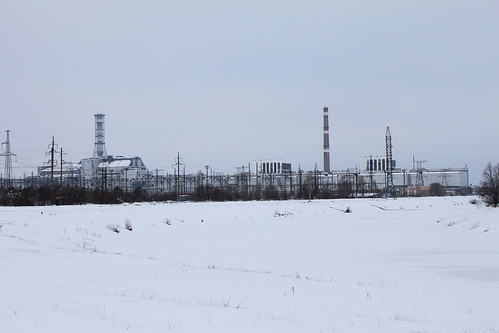
Although the reactors have been shut down since December 2000, it still serves as an active power station to control the distribution of power.
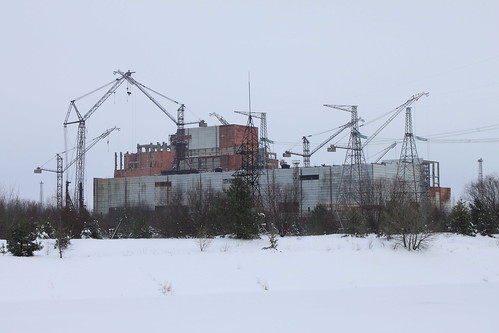
This is the site of reactors 5 and 6 that were due to be completed in October of 1986. After the accident the construction was immediately halted and the cranes haven't moved since.
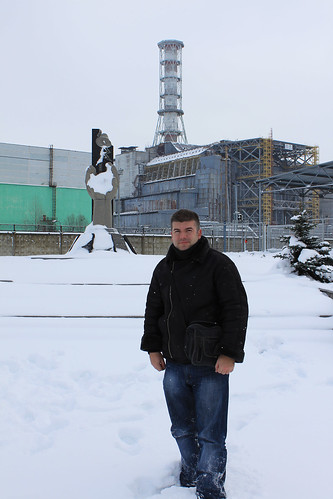
Standing in front of the structure containing reactor number 4 that exploded on April 26th, 1986. Reactors 1, 2, and 3 continued to operate until they were shut down in December 2000.
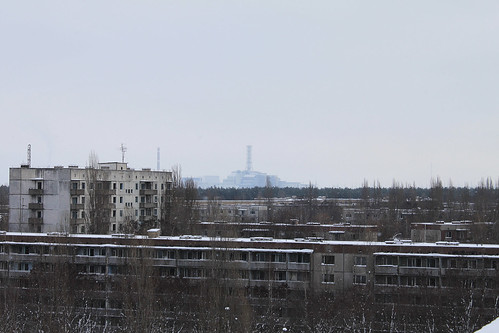
View of reactor number 4 from the roof of Hotel Polissya in Prypyat
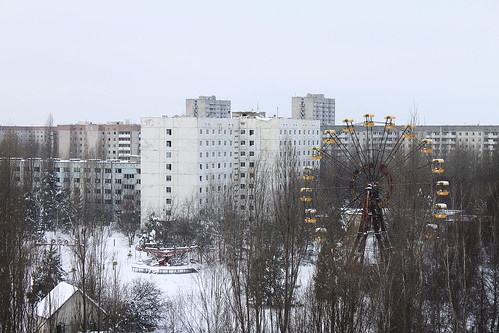
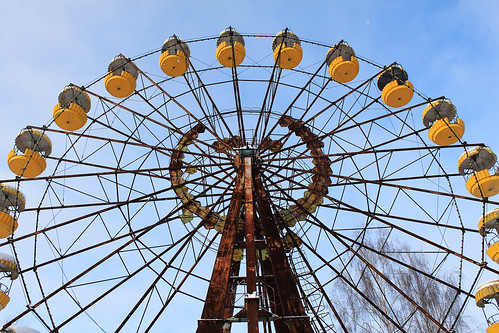
This amusement park was due to open on May 1st, 1986 to coincide with the International Day of Worker's Solidarity, but the city was evacuated just a few days before. Children never got to go on these rides.
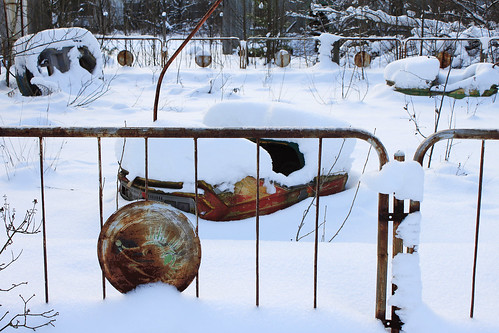
Never to be used
Hedgehog in the Fog
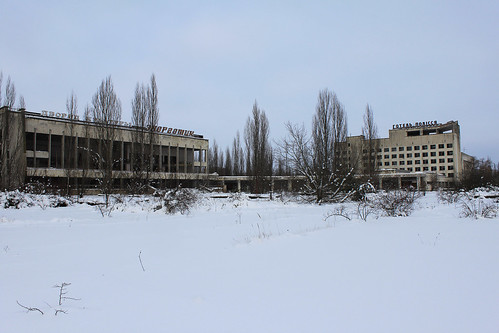
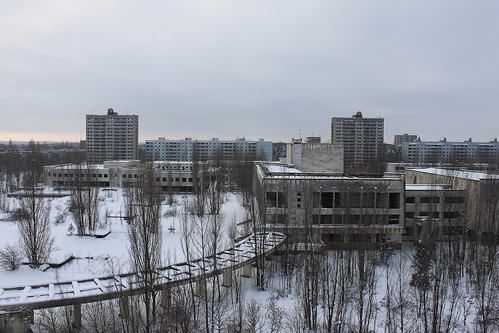
The palace of culture Energetic and Hotel Polissya in the city center
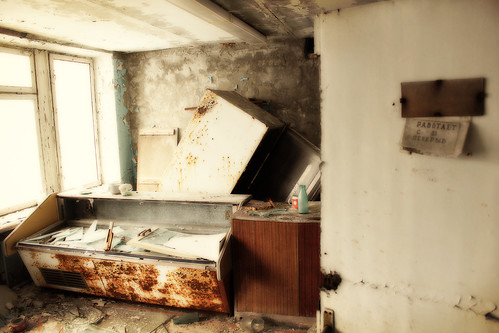
This is a snack bar on one of the floors of the hotel. The last people to stay here were the scientists, radiation experts, and Soviet government officials who were assessing the damage after the city was evacuated. They later realized that they had been exposed to lethal levels of radiation.
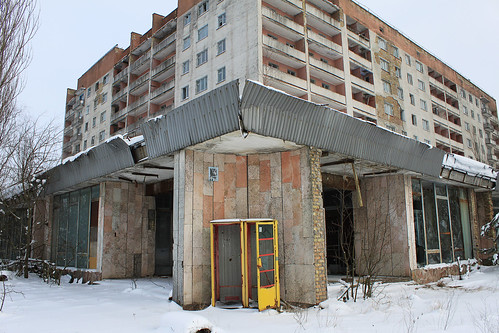
One of the many abandoned apartment buildings
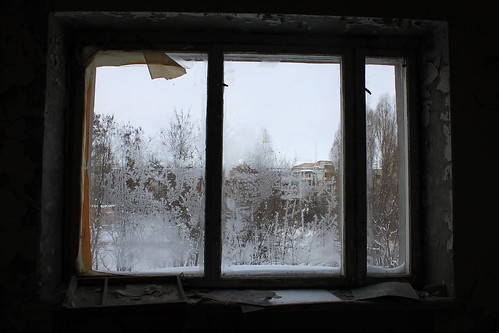
Frozen in Time: a view from an apartment window
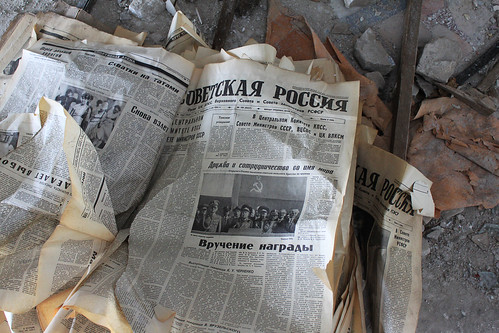
A Soviet Russia newspaper from May 6th, 1984
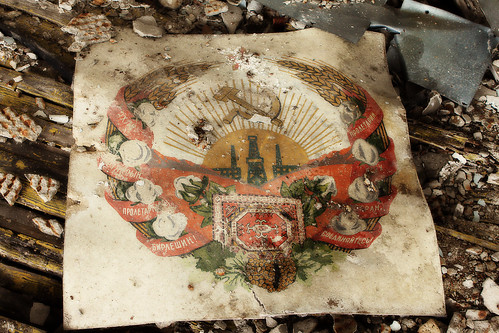
A symbol of power
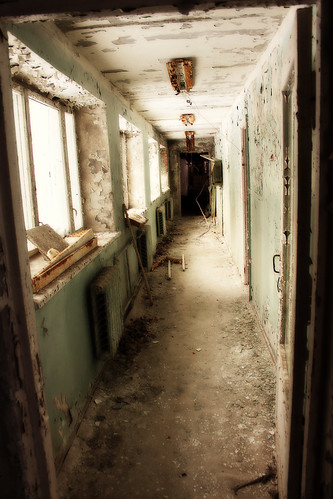
A crumbling hallway in the sports complex
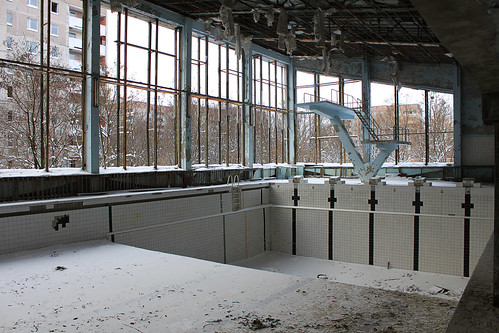
The high dive above a pool that will never see swimmers again
City restaurant and the palace of culture Energetic
The entrance into the palace of culture where community activities were held including sports and theater.
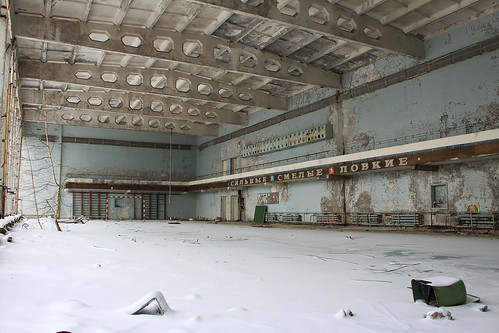
The gym inside the palace of culture. "Strong - Bold - Agile"
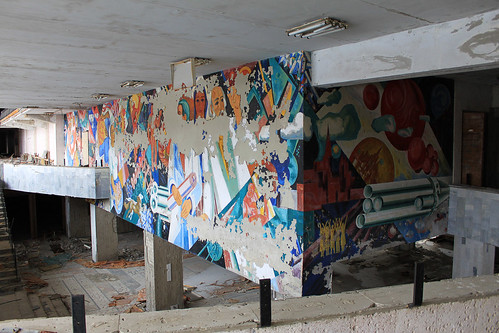
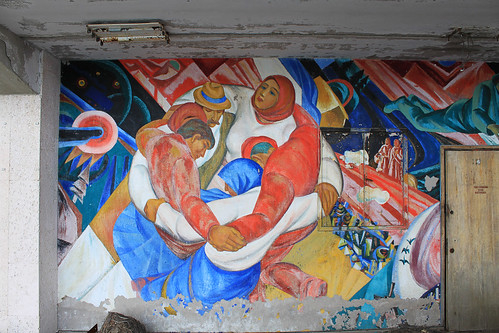
Ironically, this mural inside the palace of culture seems to be of people mourning.
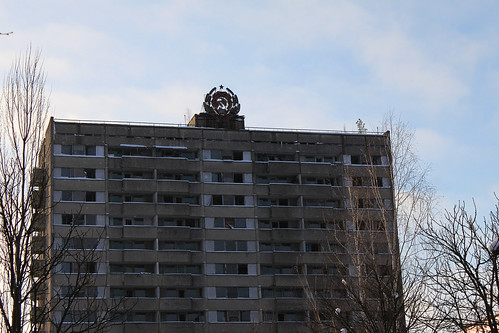
As I left Prypyat, the sun broke through the clouds just as it was setting on the Soviet hammer and sickle atop this apartment building. The disaster here began a series of events that would eventually lead to the downfall of the Soviet Union.
My time in Prypyat was a surreal experience. At times it was so quiet without the normal sounds of automobiles, electric appliances, or bustling crowds of people that it gave me a very eerie feeling. Most of the buildings and fixtures inside were familiar to me. Not much has changed in the last 23 years and several times I found myself thinking about the thousands of people who should have been there living their lives. Prypyat is a memorial to all those who died, are suffering, and have yet to suffer from what happened on the 26th day of April, 1986.
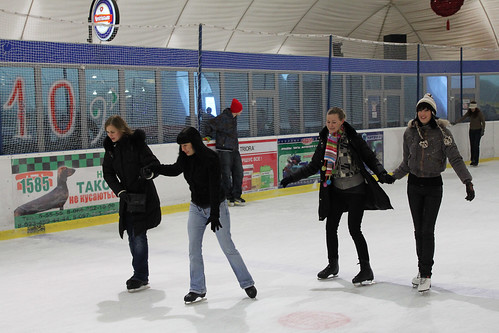
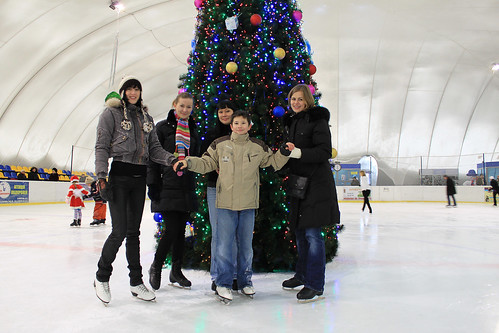
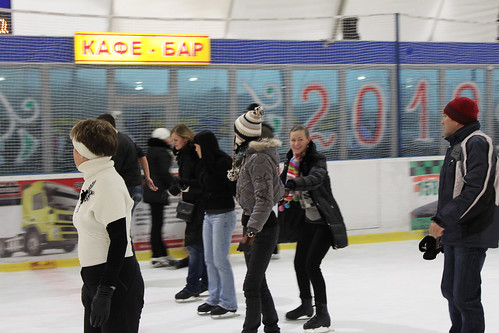
Today we finally got around to meeting up with some girls from church to go ice skating at an ice rink just a short walk from where we live. It was Joshua's second time and Edna had only been ice skating once as a child. We all had a good time and even had a chance to talk over tea afterwards in the little cafe. We were just a little sad that this was probably our last time to do something like this and I know Edna is going to really miss the close friends she has here.
Veronyka, Nastya, Edna, Joshua, and Maria
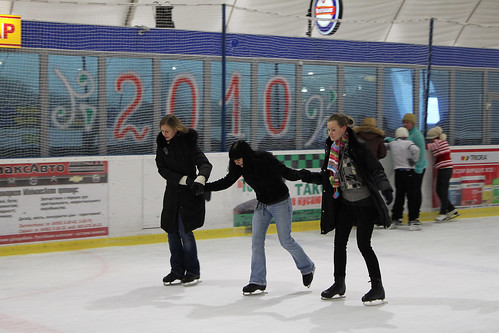
Edna was a little hesitant at first, but Maria and Nastya took good care of her.
It wasn't long before the girls had Edna speeding over the ice and they never let her fall.
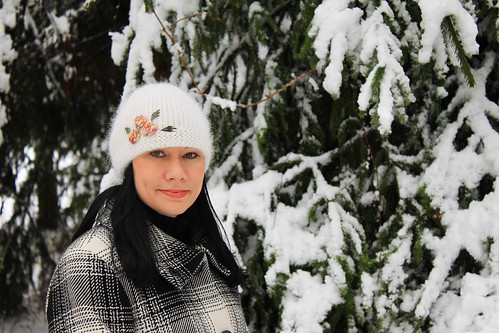
Today is Edna's birthday and I just wanted to say how much I love her and how proud I am of her kind and loving heart. She is a wonderful servant of our Lord Jesus Christ. She also was extremely patient with me this morning as I dragged her out into the cold to take pictures in the park with all the snow we got during the night.
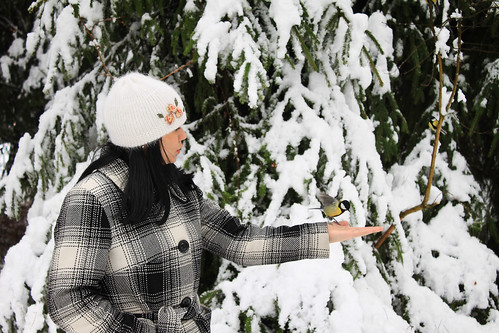
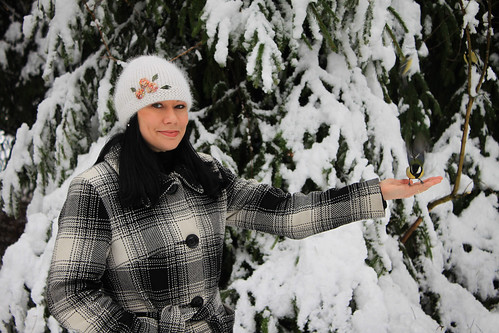
We were rewarded with these shots of birds that began taking turns landing in Edna's hand. They are use to people feeding them seeds and even though we didn't have any, they were still curious enough to check.
After taking as many pictures as possible with gusting winds and in some places having to trek through two feet of snow, Edna headed home. She hurried back to start cooking for guest that are coming over for her birthday. Even though I know that she is often in pain due to her spinal condition, she rarely complains and she always has a loving smile on her face. God has blessed me so much with my beautiful wife and best friend.
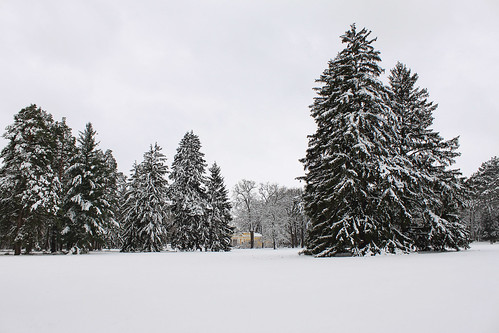
This was one of the views we were greeted with in the park this morning.
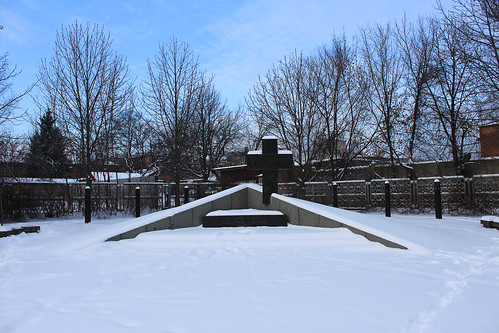
This is the city memorial for all of those who suffered and died during the genocide famine imposed by the Soviets in the winter of 1932-1933 known as Holodomor. You can see my past post about Holodomor by clicking HERE.
This is what Nadia Shulha who lived in the village of Zhovtneve about 40km from Bila Tserkva remembers about Holodomor:
"When they milled the grain, they first prepared seed for the spring planting, then set aside some for the cattle. Then they said that the machine broke, and they collected the sheaves. We went to collect the grain stalks. I went too, although I was little. The brigadier rode in on a horse and said we weren’t allowed to collect the stalks, that they were going to plow the field, and we couldn’t collect the stalks, because the tractor was coming, and collecting stalks was prohibited. So we had to stand aside. The same thing happened with the potatoes. When they dug up the potatoes, the tractors came right away to plow the field, so that people wouldn’t collect the potatoes that were left. I know this well.
I remember this because I myself went to collect these stalks. But the winter came and there was nothing left. You know, they say that you should forget these things. But you can’t forget something like this. The words of my little sister who was one year old, they’ll never leave me, “Mamo, Mamo.” But my mother had nothing to give her. I’ll never forget these words.
[My mother and father] went to Voronezh [in the Russian SFSR]. You had to go through Kyiv to get to Voronezh. [In Voronezh] they were able to trade some things for some grain and bread, and were returning home. In Kyiv there was an old and a new railroad station. You couldn’t get into the new station without a ticket, and tickets were sold only in the morning. There were hundreds of people there, not only my mother and father, and they had to wait near the old station. Just before they could go buy tickets, the police came, lined the people up, and took everything away. They could only keep one loaf of bread each. And you couldn’t say a word because they could kill you. I remember how my parents were crying when they came back. By the time they returned, two of my sisters had died. I know that they died, but where they died, in the house, or on the road, that I don’t know. I just know that they died. I know how they buried my father after he died. My father got an infection in the spring, and died. My mother’s sister, her husband and their three middle children died. In the neighboring house, the entire family died. Only the owls in the attic were left. Our other neighbors had three children, and only one girl survived. I always said the human heart is so small, but can endure so much."
This memorial is located at: 49°48'11.54"N 30° 7'23.83"E
This is my final post on the monuments of Bila Tserkva. I hope you have enjoyed learning about Ukraine and our city, Bila Tserkva.
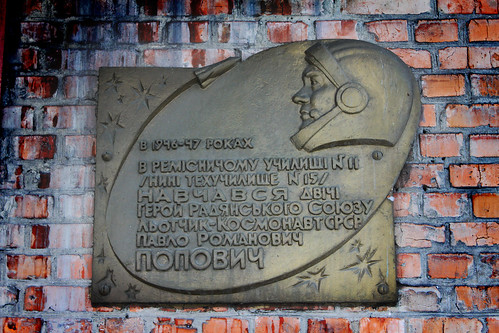
This plaque marks the building where Pavlo Popovych attended trade school from 1946 to 1947
Pavlo Romanovych Popovych was the first Ukrainian cosmonaut to go into space. He was born in Uzyn just outside of Bila Tserkva on October 5th, 1930. During WW II, the Germans occupied Uzyn, and burned documents including Popovych's birth certificate. After the war, these were restored through witness testimony, and although his mother knew that he was born in 1929, two witnesses insisted that Popovych was born in 1930, and so this became his official year of birth.
During the past few years, he lived in Crimea (southern Ukraine). Popovych had spent almost 60 years of his live in Moscow, but never forgot Ukraine. For several years he headed the Slavutych society of Ukrainian culture, and made a great contribution to the opening of the Ukrainian Culture Center on Stary Arbat in Moscow. "I am proud that I am a Ukrainian. Addressing the audience, I always say that I am the first Ukrainian cosmonaut," he used to tell the press. The first time he went into orbit was in 1962 as a pilot of the Vostok-4 spacecraft. His second flight took place 12 years later, when he headed the crew of Soyuz-14. He finished his service as the deputy head of the cosmonaut training center in charge of research work (1982-1988).
The building where he attended trade school to become a carpenter, is marked by a plaque with his likeness here in Bila Tserkva. He just passed away on September 29th, 2009 at the age of 79.
This plaque is located at: 49°48'13.65"N 30° 7'27.86"E







.jpg)
