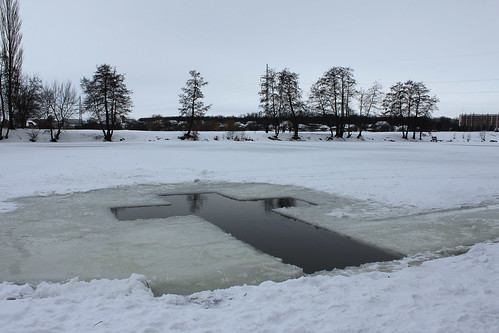
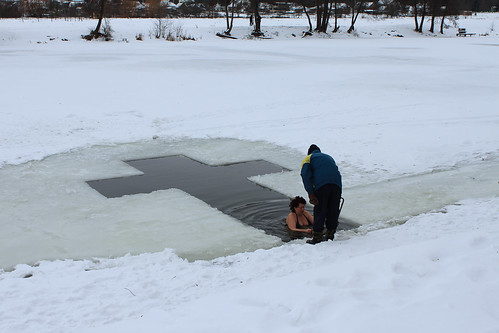
Each year on January 19th they celebrate the Baptism of Jesus and Epiphany by cutting a hole in the ice on the river here in Bila Tserkva. This happens all over Ukraine as people brave the icy waters for a triple dunking. This is an interesting sight in and of itself, but what fascinates me most is the image of the Cross intricately cut into the ice. No matter how many times I see it, I'm always drawn to it and reminded of all that it represents. It is ugly, yet beautiful. It is shameful, yet proud. It is lowly, yet exalted. It is painful, yet comforting. It is weak, yet powerful. It is bondage, yet freedom for those who believe. And if you approach the edge of this particular cross you can see a dim reflection of yourself and the world around you framed in the image of the Cross.
Now we see but a poor reflection as in a mirror; then we shall see face to face. Now I know in part; then I shall know fully, even as I am fully known.- 1 Corinthians 13:12
The first woman of the day to endure a cold dip in the ice with wind chill on the river dropping felt temperature to -21 °C ( -5 °F ).
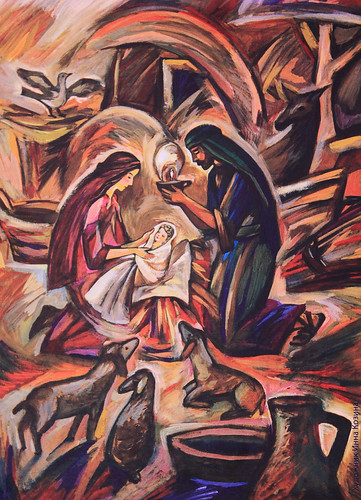
We will be spending Christmas day with our neighbor Olya and her family enjoying a meal that is sure to have way more food than any of us could ever eat. This will be our last Christmas in Ukraine and I wanted to share a little about Ukrainian Christmas with all of our friends and family outside of Ukraine.
"Sviata Vechera - A feast of twelve meatless dishes The rich traditions of Ukraine, dating back through more than a millennium of Christianity to pagan times, have been carried throughout the world to wherever the Ukrainian people have settled. And there is probably no occasion when these ancient customs are held more dear than at Christmas, when families reenact age-old observances that symbolize their deep spirituality, love of family and attachment to the land.
Traditionally Ukrainians have followed the Julian calendar, in which Christmas falls on January 7. These days many Ukrainians in North America join in the holiday festivities surrounding December 25, but continue to place a special religious emphasis on the traditions that mark Ukrainian Christmas, thirteen days later. The days leading up to the celebration are marked by spiritual preparation and fasting. The menu for the "holy supper," or sviata vechera, of Christmas Eve does not contain any meat or dairy products. The meal centres instead around grains, fish, vegetables and fruits; vegetable fats or oils are used instead of butter.
Many of the rites observed during the Ukrainian Christmas Eve meal are very ancient, going back to the pre-Christian era. Early Christians adopted these customs for themselves and invested them with new religious significance. To prepare for the meal, some hay is placed on or under the dining table, representing the manger of the baby Jesus. The table is then laid with the family's finest embroidered tablecloth, or even two tablecloths: one to represent the living members of the family, and one the dead. An extra place is always set for the souls of deceased relatives. Given place of honour in the centre of the table is the Christmas bread or kolach, consisting of three stacked rings. The number represents the Holy Trinity, and the circular shape eternity. A candle is placed in the centre to symbolize Jesus, the light of the world."
"The meal begins once the children of the family sight the first star in the evening sky, recalling the journey of the wise men towards Bethlehem. On farms, the head of the family customarily carries a sheaf of wheat called a didukh into the house, representing the family's ancestors, and places it under the household icons. (Outside, in the barn, animals are traditionally given an extra ration, honouring their role in the first Christmas.) In modern urban celebrations of the Christmas Eve meal, the sheaf may be replaced by a few wheat stalks decorating the table. The meal begins with a prayer and the traditional Christmas greeting "Khrystos rodyvsya!" (Christ is born), to which all respond "Slavite yoho!" (Let us praise him.)
Twelve dishes are served, representing the twelve apostles. Wheat shows its importance once again, for it is the main component of the special first course, called kutia, boiled kernels sweetened with honey and flavoured with poppy seeds or nuts. All members of the family must partake of a little kutia, which symbolizes prosperity for the coming year. An old superstition holds that if some of the wheat sticks to the ceiling when a spoonful of kutia is thrown into the air, the new year will be a prosperous one. These days, your hosts might prefer that this particular tradition be omitted!
Next comes soup: in this case, borshch, the famous beet soup, which for this Christmas Eve meal is made without meat or meat stock. Besides beets, the borshch may contain onions, carrots, cabbage and potatoes.
The central part of the meal is centered around fish and vegetable dishes. Fish is served baked or fried, in aspic, or pickled (perhaps whitefish or herring). An integral part of any Ukrainian meal is pyrohy or varenyky, dough dumplings filled with potato and onion, or perhaps sauerkraut or even fruit. Then there are usually two varieties of holubtsi, cabbage rolls: one stuffed with a savoury rice filling, the other with buckwheat.
There is an assortment of other vegetable side dishes: white beans mashed with onions and garlic; kapusta, or sauerkraut with onions; salads or perhaps marinated beets or mushrooms.
Towards the end of the meal, a compote of dried fruits is brought out. It may include prunes, apricots, apples and figs that have been soaked overnight and cooked with honey.
For dessert, there is an assortment of pampushky, little deep-fried pastries containing various fillings such as poppy seed or dried fruit.
This sacred and festive meal goes on for a long time. For the Ukrainian family it not only brings together decades of memories and reminiscences of beloved family members, but is also a link to centuries of proud tradition. Those gathered around the table are reluctant to get up once the meal has ended and so the family members and guests prolong the celebrations late into the night with the singing of Christmas carols."
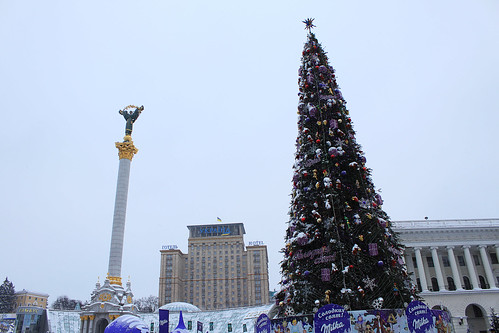
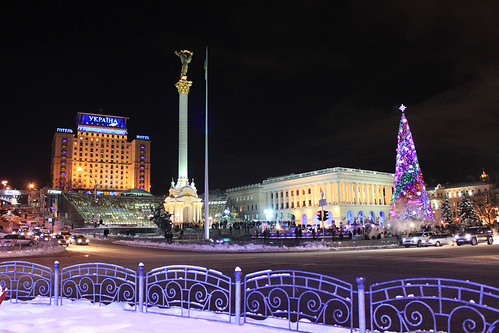
Maidan Nezalezhnosti (Independence Square) in Kyiv
This is the city memorial for all of those who suffered and died during the genocide famine imposed by the Soviets in the winter of 1932-1933 known as Holodomor. You can see my past post about Holodomor by clicking HERE.
This is what Nadia Shulha who lived in the village of Zhovtneve about 40km from Bila Tserkva remembers about Holodomor:
"When they milled the grain, they first prepared seed for the spring planting, then set aside some for the cattle. Then they said that the machine broke, and they collected the sheaves. We went to collect the grain stalks. I went too, although I was little. The brigadier rode in on a horse and said we weren’t allowed to collect the stalks, that they were going to plow the field, and we couldn’t collect the stalks, because the tractor was coming, and collecting stalks was prohibited. So we had to stand aside. The same thing happened with the potatoes. When they dug up the potatoes, the tractors came right away to plow the field, so that people wouldn’t collect the potatoes that were left. I know this well.
I remember this because I myself went to collect these stalks. But the winter came and there was nothing left. You know, they say that you should forget these things. But you can’t forget something like this. The words of my little sister who was one year old, they’ll never leave me, “Mamo, Mamo.” But my mother had nothing to give her. I’ll never forget these words.
[My mother and father] went to Voronezh [in the Russian SFSR]. You had to go through Kyiv to get to Voronezh. [In Voronezh] they were able to trade some things for some grain and bread, and were returning home. In Kyiv there was an old and a new railroad station. You couldn’t get into the new station without a ticket, and tickets were sold only in the morning. There were hundreds of people there, not only my mother and father, and they had to wait near the old station. Just before they could go buy tickets, the police came, lined the people up, and took everything away. They could only keep one loaf of bread each. And you couldn’t say a word because they could kill you. I remember how my parents were crying when they came back. By the time they returned, two of my sisters had died. I know that they died, but where they died, in the house, or on the road, that I don’t know. I just know that they died. I know how they buried my father after he died. My father got an infection in the spring, and died. My mother’s sister, her husband and their three middle children died. In the neighboring house, the entire family died. Only the owls in the attic were left. Our other neighbors had three children, and only one girl survived. I always said the human heart is so small, but can endure so much."
This memorial is located at: 49°48'11.54"N 30° 7'23.83"E
This is my final post on the monuments of Bila Tserkva. I hope you have enjoyed learning about Ukraine and our city, Bila Tserkva.
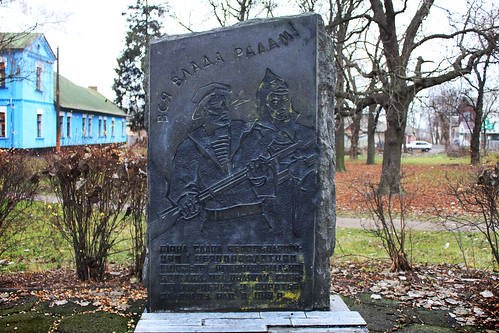
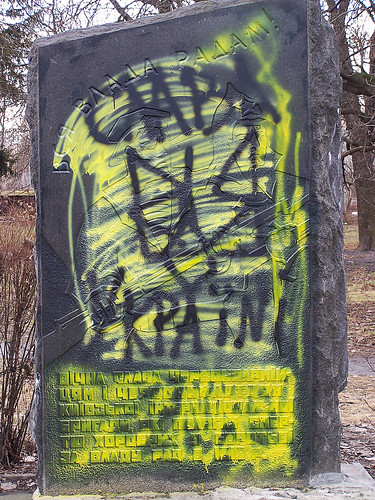
This monument is probably the most controversial in Bila Tserkva. At first glance it seems like a "harmless" Soviet Union military memorial, but a closer inspection reveals otherwise. Roughly translated, it reads, "All power to the Soviets! Eternal glory to the Red Army and Red Navy of the Kyiv international brigades that died bravely in combat for the power of the Soviets in 1919." This was in response to Ukraine declaring its independence and the war for independence that followed. The monument is to foreign (international) soldiers who eventually forced Ukraine into the Soviet Union in 1921. For obvious reasons, this is not a popular monument and it suffers from frequent acts of vandalism.
The spray paint reads, "Glory to Ukraine" and contains the national symbol of Ukraine.
This monument is located at: 49°47'41.37"N 30° 6'33.95"E
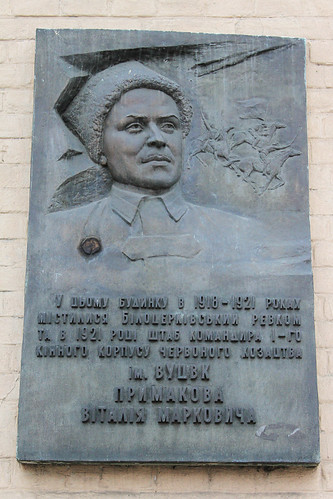
Revolutionary Committee and Vitali Markovych Prymakova
This plaque commemorates the Ukrainian Revolutionary Committee that was housed in the building it is attached to from 1918-1921. In 1921 it was used by the state commander of the 1st Calvary of the Red Kozak Army, Vitali Markovych Prymakova.
This building is located at: 49°47'47.94"N 30° 6'35.07"E
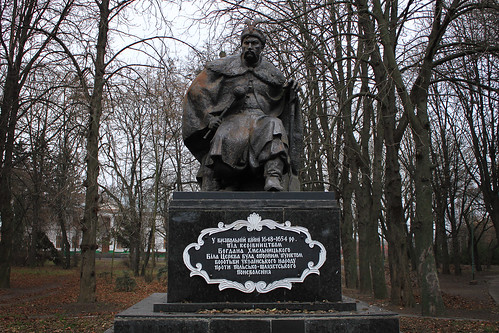
Bohdan Khmelnytsky was a Hetman of the Zaporozhian Kozak (Cossack) Hetmanate. He led the uprising against the Polish-Lithuanian Commonwealth magnates (1648–1654) which created the Kozak state. He is usually pictured holding a bulava.
Khmelnytsky is pictured on a Ukrainian five Hryven bank note.
The statue of Khmelnytsky is located at: 49°47'36.55"N 30° 6'36.64"E
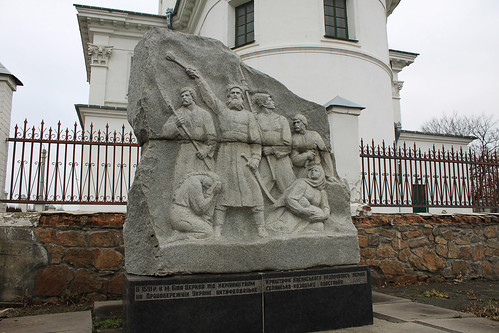
This monument commemorates the first revolt under the leadership of Kryshtofa Kosynskoho in 1591 against the feudal system by villagers and Kozaks of the right bank of Ukraine.
In Ukraine serfdom developed first in the territories ruled by Poland. Under the Polish system of serfdom the peasants were bound by law to their plots of land, which were owned by the lord. The amount of obligatory labor (corvée) owed by the peasant to the lord depended on the size and quality of the peasant's plot, but the amount of labor effectively exacted was often arbitrary. The Russian system of serfdom, which was established in most Ukrainian territories under Russian rule at the end of the 18th century, was based on the principle that the lord owned the peasant under his control. He could dispose of his serfs as he wished. He could even separate them from their land. The amount of labor owed by the peasants and the size of their allotments depended on the number of adult males in their families. Serfs were finally emancipated in 1861.
This monument is located at: 49°47'27.79"N 30° 6'32.92"E
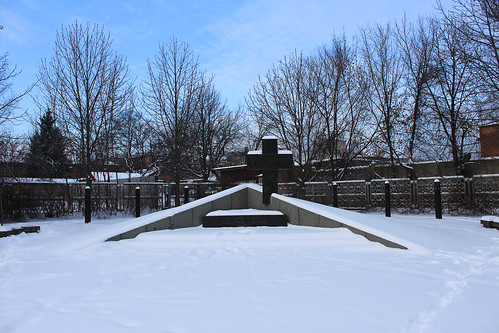
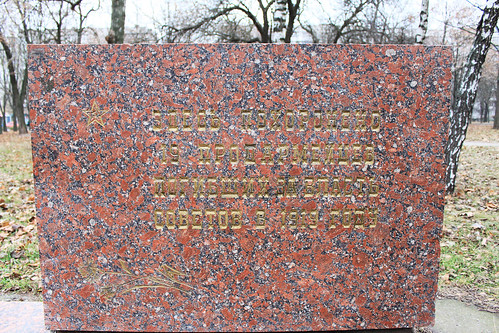
The bodies of 19 people in charge of food procurement for the Soviet Army were buried here in 1919.
This monument and burial site is somewhat obscure, but very interesting. It is located in Glory Park, but stands alone among some trees. The plaque doesn't give much detail as to what happened to these 19 people so I turned to a university historian, our friend Kolya, for information. The war from 1917 to 1921 is referred to as the Ukrainian Civil War, the Ukrainian War for Independence, and also as the Russian Civil War.
In 1917 during the First World War, the Russian Bolsheviks revolted against the Russian Tsar effectively creating what would be known as the Soviet Union. Ukraine saw this as an opportunity to break away from Imperialist Russia and declared their independence. This began a complicated series of events and struggles for power. To make a long story short, Ukraine was ultimately absorbed into the Soviet Union. You can read about the war in more detail by clicking HERE.
So as I understand it, the 19 people buried at this site were in charge of procuring food for the Red Army soldiers who were fighting against an independent Ukraine to bring Ukraine under control of the Soviet Union. These food procurement people weren't exactly going out and buying food from local vendors, but taking what they needed from the Ukrainian population. I can't imagine that these people were very popular. I don't think it's surprising that they ended up in a mass grave.
This memorial grave marker is located at: 49°48'8.36"N 30° 7'5.83"E
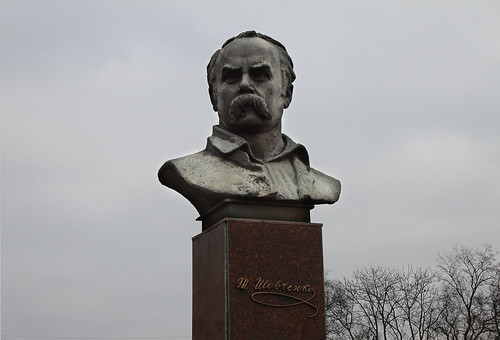
Taras Hryhorovych Shevchenko, Ukrainian poet and artist
I think Shevchenko is one of the most recognized symbols of Ukrainian culture. His birthday on March 9th, is widely celebrated (as you can see on the website of the President of Ukraine) and almost every city in Ukraine has a monument, street, square, or park named after him.
Born into a serf family in the village of Moryntsi, of Kyiv Governorate of the Russian Empire (now in Cherkasy Oblast, Ukraine) Shevchenko was orphaned at the age of eleven. He was taught to read by a village precentor, and loved to draw at every opportunity. Shevchenko went with his Russian aristocrat lord Pavel Engelhardt to Vilna and then to Saint Petersburg.
Works
He began writing poetry while he was a serf and in 1840 his first collection of poetry, Kobzar, was published. Ivan Franko, the renowned Ukrainian poet in the generation after Shevchenko, had this to say of the compilation: "[Kobzar] immediately revealed, as it were, a new world of poetry. It burst forth like a spring of clear, cold water, and sparkled with a clarity, breadth and elegance of artistic expression not previously known in Ukrainian writing".
In 1841, the epic poem Haidamaky was released. In September 1841, Shevchenko was awarded his third Silver Medal for The Gypsy Fortune Teller. Shevchenko also wrote plays. In 1842, he released a part of the tragedy Mykyta Hayday and in 1843 he completed the drama Nazar Stodolya.
While residing in Saint Petersburg, Shevchenko made three trips to the regions of modern Ukraine, in 1843, 1845, and 1846. The difficult conditions under which his countrymen lived had a profound impact on the poet-painter. Shevchenko visited his still enserfed siblings and other relatives, met with prominent Ukrainian writers and intellectuals such as: Yevhen Hrebinka, Panteleimon Kulish, and Mykhaylo Maksymovych, and was befriended by the princely Repnin family especially Varvara Repnina.
In 1844, distressed by the condition of Ukrainian regions in the Russian Empire, Shevchenko decided to capture some of his homeland's historical ruins and cultural monuments in an album of etchings, which he called Picturesque Ukraine.
Exile
On March 22, 1845, the Council of the Academy of Arts granted Shevchenko the title of an artist. He again travelled to Ukraine where he met historian Nikolay Kostomarov and other members of the Brotherhood of Saints Cyril and Methodius, a Pan-Slavist political society dedicated to the political liberalization of the Empire and transforming it into a federation-like polity of Slavic nations. Upon the society's suppression by the authorities, Shevchenko was arrested along with other members on April 5, 1847. Although he probably was not an official member of the Brotherhood, during the search his poem "The Dream" ("Son") was found. This poem criticized imperial rule, personally attacked Emperor Nicholas I and his wife Alexandra Feodorovna, and therefore was considered extremely inflammatory, and of all the members of the dismantled society Shevchenko was punished most severely.
Shevchenko was sent to prison in Saint Petersburg. He was exiled as a private with the Russian military Orenburg garrison at Orsk, near Orenburg, near the Ural Mountains. Tsar Nicholas I, confirming his sentence, added to it, "Under the strictest surveillance, without a right to write or paint."
With the exception of some short periods of his exile, the enforcement of the Tsar's ban on his creative work was lax. The poet produced several drawings and sketches as well as writings while serving and traveling on assignment in the Ural regions and areas in modern Kazakhstan.
But it was not until 1857 that Shevchenko finally returned from exile after receiving a pardon, though he was not permitted to return to St. Petersburg but was ordered to Nizhniy Novgorod. In May 1859, Shevchenko got permission to move to his native Ukraine. He intended to buy a plot of land not far from the village of Pekariv and settle in Ukraine. In July, he was arrested on a charge of blasphemy, but was released and ordered to return to St. Petersburg.
Death
Taras Shevchenko spent the last years of his life working on new poetry, paintings, and engravings, as well as editing his older works. But after his difficult years in exile his final illness proved too much. Shevchenko died in Saint Petersburg on March 10, 1861, the day after his 47th birthday.
He was first buried at the Smolensk Cemetery in Saint Petersburg. However, fulfilling Shevchenko's wish, expressed in his poem "Testament" ("Zapovit"), to be buried in Ukraine, his friends arranged to transfer his remains by train to Moscow and then by horse-drawn wagon to his native land. Shevchenko's remains were buried on May 8th on Chernecha Hill (Monk's Hill; now Taras Hill) by the Dnipro River near Kaniv. A tall mound was erected over his grave, now a memorial part of the Kaniv Museum-Preserve.
Dogged by terrible misfortune in love and life, the poet died seven days before the Emancipation of Serfs was announced. His works and life are revered by Ukrainians and his impact on Ukrainian literature is immense.
Impact
Taras Shevchenko has a unique place in Ukrainian cultural history and in world literature. His writings formed the foundation for the modern Ukrainian literature to a degree that he is also considered the founder of the modern written Ukrainian language (although Ivan Kotlyarevsky pioneered the literary work in what was close to the modern Ukrainian in the end of the eighteenth century.) Shevchenko's poetry contributed greatly to the growth of Ukrainian national consciousness, and his influence on various facets of Ukrainian intellectual, literary, and national life is still felt to this day. Influenced by Romanticism, Shevchenko managed to find his own manner of poetic expression that encompassed themes and ideas germane to Ukraine and his personal vision of its past and future.
In view of his literary importance, the impact of his artistic work is often missed, although his contemporaries valued his artistic work no less, or perhaps even more, than his literary work. A great number of his pictures, drawings and etchings preserved to this day testify to his unique artistic talent. He also experimented with photography and it is little known that Shevchenko may be considered to have pioneered the art of etching in the Russian Empire (in 1860 he was awarded the title of Academician in the Imperial Academy of Arts specifically for his achievements in etching.)
His influence on Ukrainian culture has been so immense, that even during Soviet times, the official position was to downplay strong Ukrainian nationalism expressed in his poetry, suppressing any mention of it, and to put an emphasis on the social and anti-Tsarist aspects of his legacy, the Class struggle within the Russian Empire. Shevchenko, who himself was born a serf and suffered tremendously for his political views in opposition to the established order of the Empire, was presented in the Soviet times as an internationalist who stood up in general for the plight of the poor classes exploited by the reactionary political regime rather than the vocal proponent of the Ukrainian national idea.
This view is significantly revised in modern independent Ukraine, where he is now viewed as almost an iconic figure with unmatched significance for the Ukrainian nation, a view that has been mostly shared all along by the Ukrainian diaspora that has always revered Shevchenko.
A young Shevchenko on a Ukrainian 100 Hryven note
Here's one of Shevchenko's poems translated into English:
My Friendly Epistle
To the Dead, the Living, and to Those Yet Unborn, My Countrymen all Who Live in Ukraine and Outside Ukraine,
If a man say, I Love God, and hate his brother, he is a liar, 1 John iv. 20
Day dawns, then comes the twilight grey, The limit of the live-long day; For weary people sleep seems best And all God's creatures go to rest. I, only, grieve like one accursed, Through all the hours both last and first, Sad at the crossroads, day and night, With no one there to see my plight; No one can see me, no one knows me; All men are deaf, no ears disclose me; Men stand and trade their mutual chains And barter truth for filthy gains, Committing shame against the Lord By harnessing for black reward People in yokes and sowing evil In fields commissioned by the Devil... And what will sprout? You soon will see What kind of harvest there will be! Come to your senses, ruthless ones, O stupid children, Folly's sons! And bring that peaceftil paradise, Your own Ukraine, before your eyes; Then let your heart, in love sincere, Embrace her mighty ruin here! Break then your chains, in love unite, Nor seek in foreign lands the sight Of things not even found above, Still less in lands that strangers love... Then in your own house you will see True justice, strength, and liberty!
Gain knowledge, brothers! Think and read, And to your neighbours' gifts pay heed, -- Yet do not thus neglect your own: For he who is forgetful shown Of his own mother, graceless elf, Is punished by our God Himself. Strangers will turn from such as he And grudge him hospitality -- Nay, his own children grow estranged; Though one so evil may have ranged The whole wide earth, he shall not find A home to give him peace of mind.
Sadly I weep when I recall The unforgotten deeds of all Our ancestors: their toilsome deeds! Could I forget their pangs and needs, I, as my price, would than suppress Half of my own life's happiness...
Such is our glory, sad and plain, The glory of our own Ukraine! I would advise you so to read That you may see, in very deed, No dream but all the wrongs of old That burial mounds might here unfold Before your eyes in martyred hosts, That you might ask those grisly ghosts: Who were the tortured ones, in fact, And why, and when, were they so racked?...
Then 0 my brothers, as a start, Come, clasp your brothers to your heart, -- So let your mother smile with joy And dry her tears without annoy. Blest be your children in these lands By touch of your toil-hardened hands, And, duly washed, kissed let them be With lips that speak of liberty! Then all the shame of days of old, Forgotten, shall no more be told; Then shall our day of hope arrive, Ukrainian glory shall revive, No twilight but the dawn shall render And break forth into novel splendour.... Brother, embrace! Your hopes possess, I beg you in all eagerness!
The Shevchenko monument is located here: 49°47'32.09"N 30° 6'54.01"E
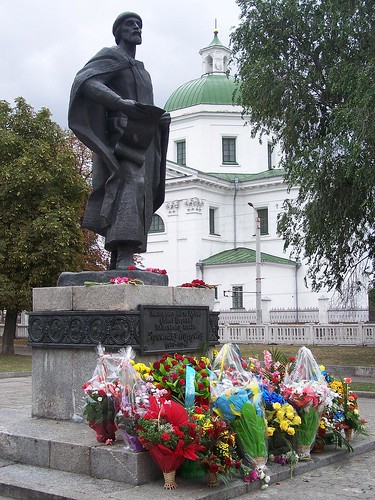
Yaroslav the Wise with the church of St. John in the background
Inspired by A Soviet Poster a Day blog, I decided to focus on a monument a day in the city of Bila Tserkva where we live. The monuments are testimony to the history of Bila Tserkva and of Ukraine in general, so I thought it would be a fun way to share it with everyone. Most cities in Ukraine are filled with monuments and memorials of historical importance. The majority of these are dedicated to The Great Patriotic War (World War II). Even small villages will usually have at least one memorial. Hopefully this will be interesting as well as educational and through it you will come to know and love Ukraine. I will also include the GPS coordinates in case anyone wants to see the location on Google Earth or better yet, actually come and visit Bila Tserkva.
It's only fitting that the first monument be of our city founder, Yaroslav the Wise. He founded Bila Tserkva in 1032, making it, as of this year, 977 years old. Yaroslav, 978-1054, grand duke of Kyiv (1019–1054); son of Vladimir I. Designated by his father to rule in Novgorod, he became grand duke of Kyiv after defeating his older brother Sviatopolk, who succeeded Vladimir I. A shrewd statesman, he consolidated the power and prestige of Kyivan Rus. He regained West Galicia from the Poles (who had obtained it in return for supporting Sviatopolk), crushed (1036) the Pechenegs (nomadic invaders), and suppressed rebellions by Lithuanian and Finnish tribes. In 1043 he organized the last Rus campaign against Constantinople, in which his troops were routed. At home he encouraged learning, codified laws, erected magnificent buildings and churches, including the famous Cathedral of St. Sophia, and founded (1039) a patriarchate in Kyiv. Yaroslav was in close contact with European dynasties; his daughters were married to Harold III of Norway, Andrew I of Hungary, and Henry I of France. Before his death Yaroslav divided his kingdom among his heirs, designating the oldest, Iziaslav, as grand duke of Kyiv. The others were told to obey Iziaslav as they had their father, but civil war ensued.
Yaroslav is pictured on the Ukrainian two Hryvni note with the Cathedral of St. Sophia in Kyiv on the reverse.
The statue of Yaroslav the wise stands at: 49°47'28.74"N 30° 6'30.73"E
Just a reminder that today is International Holodomor Memorial Day and this is the time of year that Ukrainians around the world remember the horrors of Holodomor, the genocide famine of 1932-1933. An estimated 7-10 million people starved to death at the hands of the Soviet government. The Ukrainian Canadian Congress is urging all Canadians to let the world know the truth of this tragedy. Please read the testimonies and hear the stories of the survivors by clicking HERE. Many people here in Ukraine still live with these nightmares. Let us never forget.
Here's part of the testimony of Maria Katchmar:
"My [grandmother] gave my [mother] all her property – the barn, the land, and the livestock. Later they took it all away from us because they said we were kulaks. My father was sent to Siberia. They took all the livestock and told my father to drown it, but he said he’d rather sit in prison than drown the livestock. And he didn’t drown them, but other people did. They took everything from people. In our house, they broke all the windows, all the doors, all the paintings, and took all the linens, so that we couldn’t sleep in the house. So we slept outside. Our neighbor had a goat, and gave us glass of milk and some frostbitten potatoes every day. She ripped leaves off the trees and made pancakes, and that’s how she supported us. Mother went somewhere to find some food, and didn’t return until a month later. She brought us some beans and peas, but there was nothing to cook in, because they had broken all the pots. She borrowed a pot from our neighbor and cooked us some soup. She went again to look for food, but there was none. There was absolutely nothing to eat. We ate grass. Mostly we ate pancakes made of leaves and frostbitten potatoes that our neighbor gave us. That’s how she saved us. They took our land, our orchard, everything my grandmother had left for my mother. They said we were kulaks and didn’t have any right to it.
Almost everyone died. There was usually either just one man or one woman left [from each family]. Almost all the children died. Very few survived. Maybe some people had some gold that they could trade, but we didn’t have any. We had two cows, chickens and pigs – they took it all. What are you going to eat? There’s nothing left to eat. They didn’t bury anyone. A big cart that was used to haul cement, picked corpses up by the arms and legs, threw them on and took them to a pit.
They had a pit and threw them in, like mud. The pit was big enough for the entire village. Eight [of my siblings] died. There were ten of us, and two of us survived. I don’t know, I can’t fathom what misery this was. God forbid that anyone have to live through what I lived through. I remember sometimes now, and I don’t even want to think about it."
By the way, the current Russian government still officially denies that a genocide occurred.
Olya and Halya unpacking the food as Joshua and Edna watch.
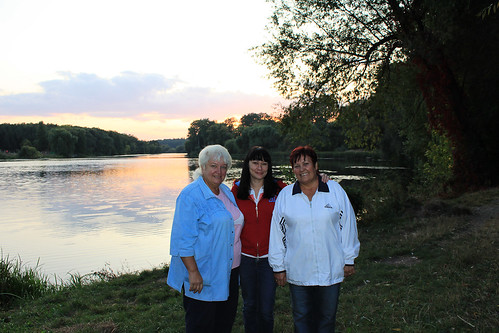
Yesterday our neighbor Olya knocked on our door and invited us to have a late lunch with her and her friend Halya in the park. She told us that they had waited for us because they knew we did school work with the boys in the morning. We had just finished the boys' school lessons so it was perfect timing. Dominic opted to stay home (his loss as Olya is famous with us for her delicious cooking). We knew by the smell of food making its way into our apartment that she had been cooking all morning. We quickly packed up a few things and headed for the park with her and her friend.
Some color in the park
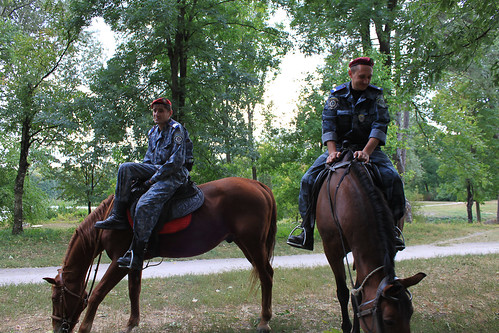
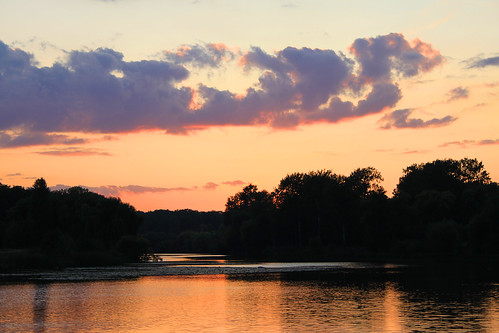
I'm not sure exactly how long we stayed in the park (it was sunset when we left), but we had a lot of fun listening to the two women's stories and watching all the different people go by. There were the joggers that Olya jokingly asked if she could jog with. There was the lady with the old dog named Julia (who by the way was a male, the dog not the lady). She was afraid he was going to choke on the bone we gave him. There was the man on the scooter who was singing the whole time as he gathered grass, probably for his cow. There was a group of tourists from Kyiv who really wanted our picnic spot, but we politely refused to leave. There was the little old lady collecting bottles from the trash who we put together a bag of food for. There was the man on the bicycle who was filling jugs of water at a nearby spring and generously offered us some as he explained that God gives living water (the most profound statement of the day). There was a little stray dog and his female companion. The poor little guy had such a bad under bite, that we couldn't stop laughing every time he would come up to us to beg for more food. Then there were the two police officers who rode up to us on horses. They were nice enough and let me take their picture.
The police let us feed their horses some bread.
Olya, Edna, and Halya on the bank of the River Ros at sunset.
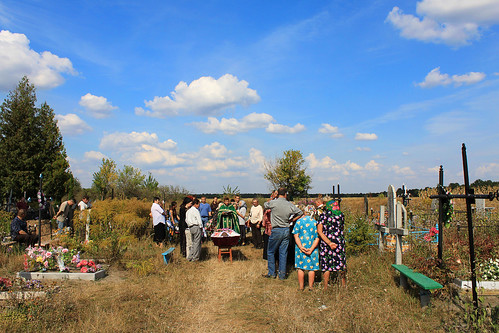
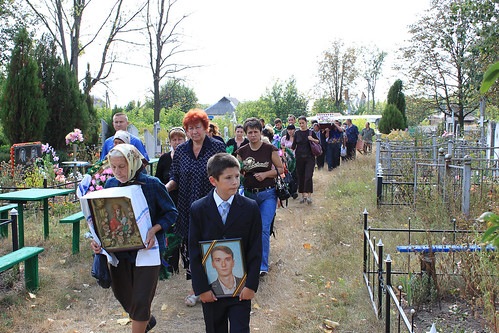
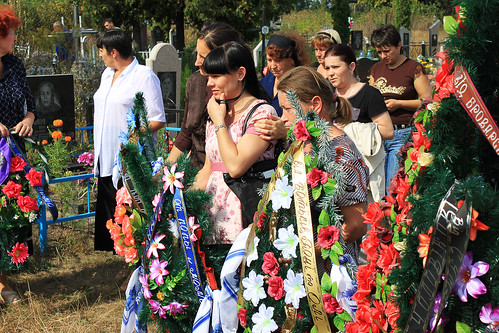
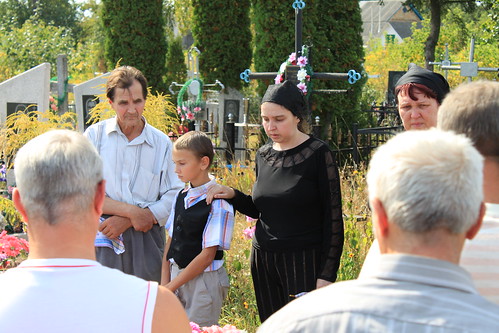
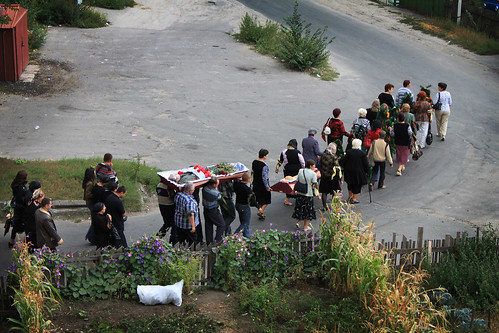
Yesterday was the funeral for Maxime's father, Andriy. It was one of the saddest funerals I have ever been to. It was hard to watch as a mother and father held their son, as a brother said goodbye to his brother, as a wife kissed her husband, and a son saw his father, all for the last time.
Joshua led the procession with a photo of Andriy.
I'm just glad that we were able to be there for Maxime and his family. His grandmother, Luda, and his grandfather were very thankful that we were there and that I could take photos for them. Tanya from Pryluky was also able to be there for the funeral and I know Maxime was happy that someone had come all that way just to be there for him. Joshua and Dominic were the only ones Maxime's age at the funeral, so I'm sure it helped him to know they were there for him too.
Tanya and Edna holding flower wreaths.
Thank you for all of your prayers. Maxime's grandmother, Luda, has said that Maxime and his mother will probably move in with them in the front house. They had previously lived in an attached section that had one bedroom and no indoor plumbing. Maxime's grandfather actually locked up the place where Maxime had been living and said that he didn't want anyone going back in there again. This is a blessing because that place was beyond any description I could give.
Maxime and his mother, Vera
Now we are going to be working with Maxime's grandmother to make sure that Maxime is provided for. His grandparents are pensioners and his mother has no income so we are going to try and get the necessities that he needs. Maxime has no bedding or sheets to sleep on so this will be the first thing we will try to get for him. He is also going to need clothes, especially with winter approaching. Right now, Maxime doesn't even have a pair of socks to wear. We had to give him some of Joshua's clothes so that he would have something to wear for the funeral. If you'd like to help us purchase any of these things, please contact us through email (if you don't have it, you can click HERE and then click the email link under Contact).
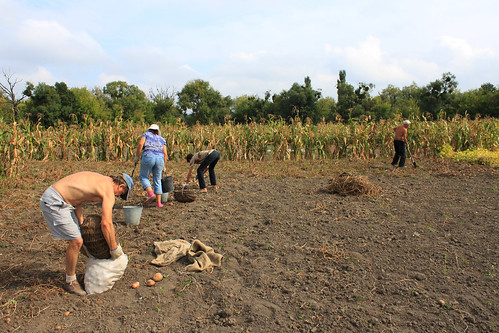
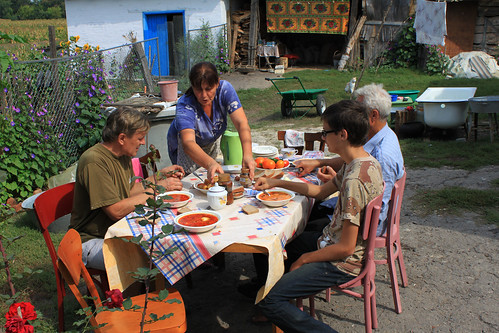
Yesterday, Dominic and I went to the village of Kozhenyky to help harvest potatoes. We've done this before and it's our way of helping a family in the church that owns the home and land there. It's hard work, but we also have fun along the way and they feed us really well.
Lunch Break (red borshch and holubtsi)
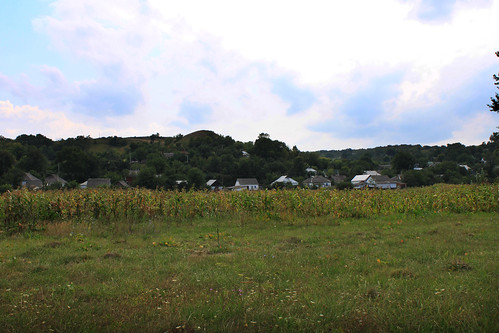
They tell us that the village is dying. There are no young people there anymore. They've all moved away. As the older people in the village die, their homes are often just boarded up. We've heard that the village is down to just one cow now as cows are a lot of work to care for.
The road out of the village goes up the hill to the far right.
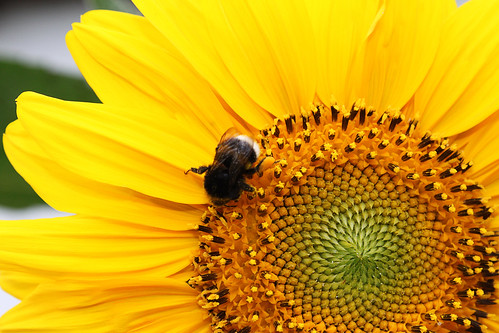
Collecting pollen.
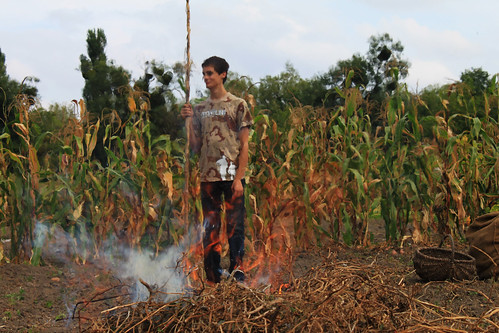
Dominic burning the dead potato vegetation.
It appears that, unbeknownst to Dominic, he was being stalked by the grim reaper.
Looking around at how difficult life is there, I can understand how young people would want to move away. There is no running water or toilets and most people live off of the animals they raise and the crops they grow. Potatoes are of course the most important crop and the most labor intensive. They are also solely dependent on God's provision of rain for water.
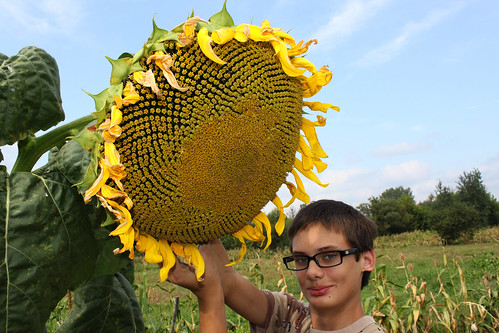
Biggest sunflower ever?
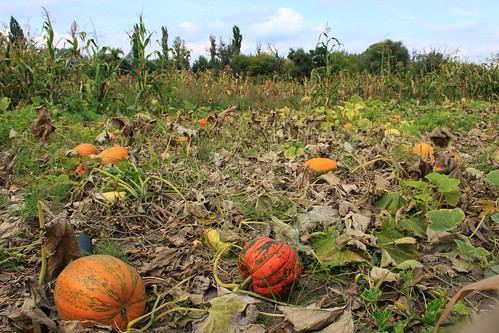
Pumpkins and more.
The potatoes that are harvested must last people until the next year. Nothing goes to waste. The potatoes are sorted and any that are damaged are fed to their animals. Potatoes can also be sold or traded. So as I looked around at other people digging neighboring plots of land, I realized that they were literally digging for their lives.
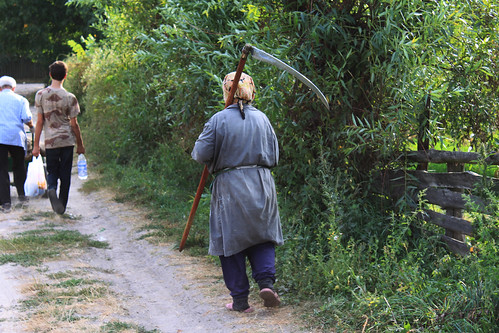
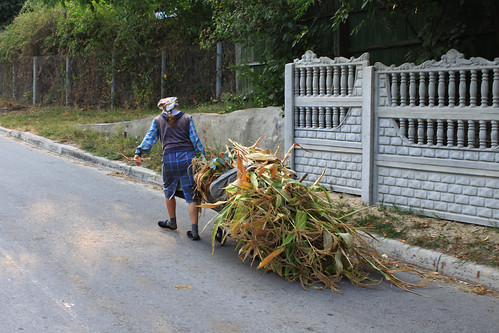
This woman had been in the field next to us collecting vegetables and some grass for the one remaining cow in the village. She was lugging a full load up the steep hill using an old baby carriage.
Yesterday, a man in our building died while riding his bicycle to work. Today, he was buried. It’s a reminder to me of how fragile we are and the simple fact that we are all perishing. Some of us will have eternal life in Christ because we have chosen to follow him, while others will not.
I can’t help but wonder what effect death has on our lives. Growing up in California, I feel as though I was shielded from death in a way. Of course I attended the occasional funeral of deceased relatives, but with limited exposure to death. Death was something associated with funeral homes and cemeteries. I suspect this is the case for the average American as well. Does this lead us to forget or at least not think about our momentary existence in this world?
In Ukraine, death is part of life. There is little attempt to hide or disguise it. Funerals generally take place at home with the help of friends, family, and neighbors. If you live in an apartment building, you can’t avoid being a part of or at least seeing a funeral every couple of months or so. Does this constant reminder of mortality cause people to examine eternity more closely or simply become numb to it? I don’t know, but I do know that I am more driven than ever to make known to the person I pass every day on the stairs that salvation comes from only one source, Jesus Christ.
Jesus answered, "I am the way and the truth and the life. No one comes to the Father except through me." -John 14:6
For my Father's will is that everyone who looks to the Son and believes in him shall have eternal life, and I will raise him up at the last day. -John 6:40 A friend of mine, Jeremy Foster, recently wrote this on his blog about death.
"Just a thought with this: oftentimes when a Christian dies, people say something to the extent that the person has gone to a better place. "A better place"? I appreciate the sentiment, but in reality, that is possibly/probably the greatest understatement in the universe. In all actuality, there is no better place anywhere. For the believer in Jesus, earth is the closest thing we'll ever have to hell. For the non-believer on the other hand, earth is the closest thing they'll ever have to heaven."
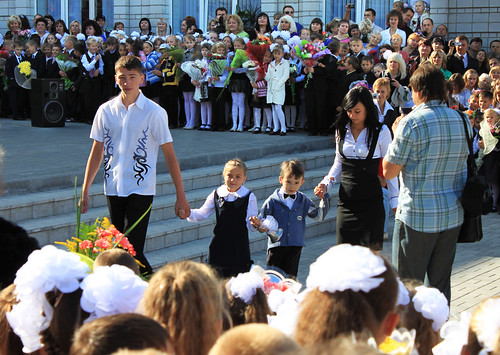
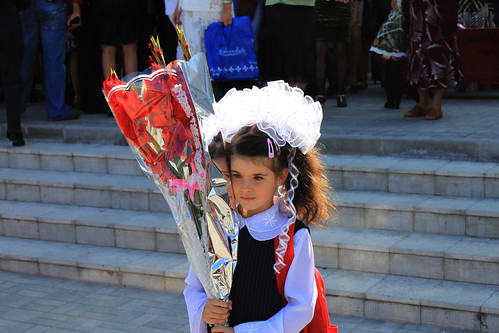
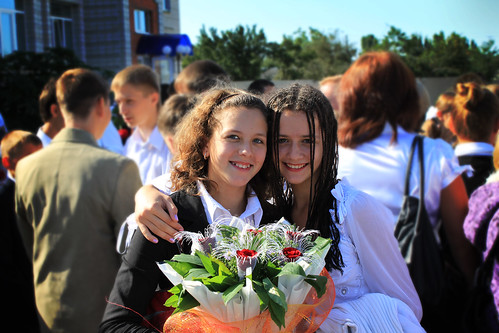
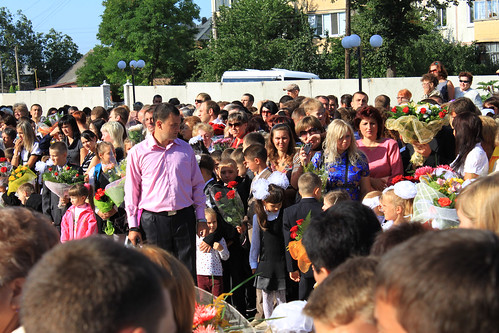
Today was the first day of school in Ukraine and even though the boys are staying home this year to focus on home schooling, I decided to go anyway. Since we know so many of the children, it felt a little like we were sending our own kids off to school.
Our neighbor Oksana
The ceremony had pretty much the same format as last year, but instead of a little girl riding on the shoulders of an older student and ringing the bell, they did things a little different. This year they had a boy and a girl ring the bell together as they were flanked by two older students.
Oksana and Alina
All the children dress up for the first day of school and bring their teachers bouquets of flowers. It broke my heart to see Maxime after the ceremony standing in the back wearing basically the same clothes he had been wearing on the playground the day before and looking a little bit dirty. I realized that he hadn't stood with his classmates. He didn't have a back pack or even a bag to carry his new books in like the other kids either. It really bothered me that his parents did absolutely nothing for him on his first day of school as he goes into 7th grade. At least I was there for him and was able to tell him to be happy as he went off to his class room. Hopefully that meant something.
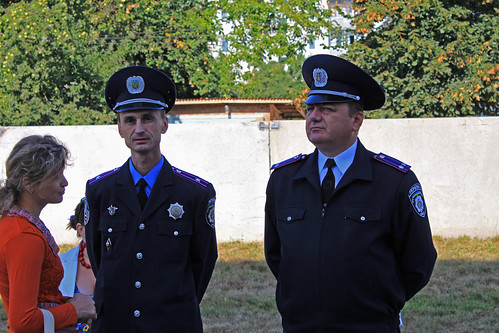
Two police officers attending the event just in case things get out of hand. (just kidding) The officer on the left is Alina's father and her mother is next to him.
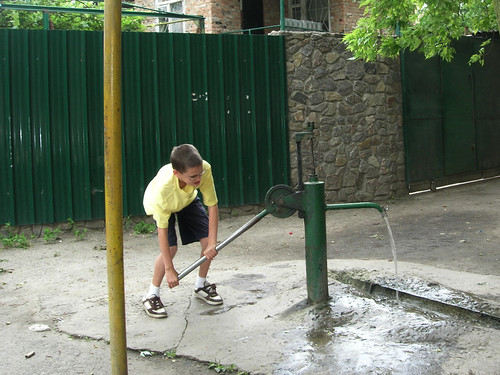
While we were in California, we really enjoyed the fact that we could get fresh, clean well water right out of the tap. Here in Ukraine we have three options for drinking water. You can filter the tap water, which we do in a small pitcher for cooking and making tea, you can get your water straight from the well, or you can buy drinking water.
Dominic at the then working pump about two years ago.
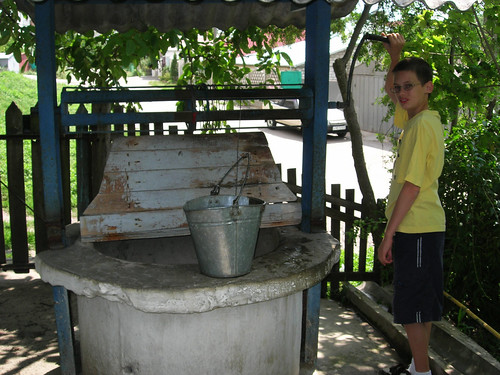
I usually prefer to get water from a nearby well that has a hand pump on it. Unfortunately, the pump has broken or been vandalized at least twice now. It is currently capped off and it is uncertain if it will be repaired again. There is, however, a traditional open well with a bucket and chain just outside of our apartment, but I try to avoid drinking that water as it tends to have undesirable things fall into it. You know, sorts of things like bugs and frogs. It works just fine for flushing the toilet when the water in the building is turned off, but probably not the best for drinking. I just heard yesterday that someone found a dead cat in their well. This was a well that I drank from on several previous occasions. I've decided to try and limit my water intake from these types of open wells in the future.
Dominic demonstrating the well just outside of our building two years ago.
Just recently, a schedule was posted for a water truck that would be selling water in our neighborhood. Coincidentally, this happened to coincide with the timing of the pump being capped off. (Could there be any sinister connection here or just good timing?) Anyway, we just take our water jugs down and get them filled with what appears to be pretty good drinking water. It's a deal at about six cents a liter.
I just think it's interesting that it's perfectly normal to have a discussion about where and how someone gets their drinking water here in Ukraine. Another interesting topic for discussion is who knows the best source for fresh milk, but that's a whole different story.
Jesus answered, "Everyone who drinks this water will be thirsty again, but whoever drinks the water I give him will never thirst. Indeed, the water I give him will become in him a spring of water welling up to eternal life." - John 4:13-14